The question everyone asks
If you use an injectable on a regular schedule, sooner or later you'll ask: which side did I use last time? Memory is unreliable, especially with more than one compound or a schedule that isn't daily. Your prescriber or health professional will usually advise rotating sites, and that's much easier when there's a record.
What a rotation record should show
A useful record answers three questions at a glance:
- Where: the exact site, such as the left or right side of the abdomen, or a thigh.
- When: the date and time of each one.
- How long since: which sites have had the longest break since they were last used.
Notes and calendar entries can hold this, but they're slow to check in the moment. A picture of the body is much faster to read than a list of dates.
Make it part of logging
The easiest records are the ones you don't have to think about. If you choose the site at the same moment you log, the history builds itself. There's no separate diary to keep.
Review the history
Looking back over a month can show habits you didn't notice, such as always using the same side, or skipping a whole area. It's also useful to have on hand if your health professional asks.
Where the app comes in
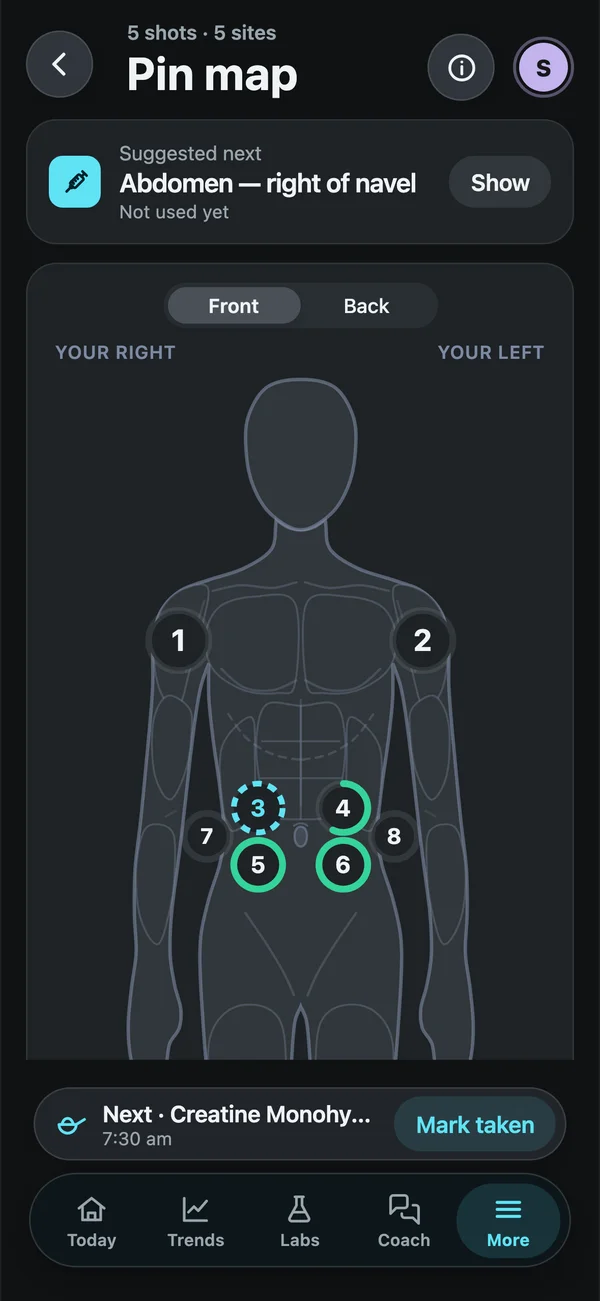
Biohack Tracker has a Pin map: a front and back view of the body with numbered sites. Each time you log, you tap the site you used. Every site shows a ring that fills as it rests, and the map shows which site has had the longest break as a suggested next spot. Tap any site to see when it was last used and its full history. The schedule and the choice of site always stay with you and your health professional; the map just keeps the record.
